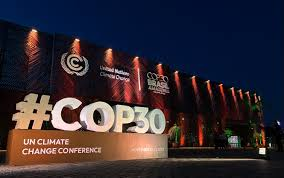
What Is COP30?
The 2025 United Nations Climate Change Conference, or Conference of the Parties of the United Nations Framework Convention on Climate Change (UNFCCC), more commonly known as COP30, is the upcoming 30th United Nations Climate Change Conference, to be held in Belém, Brazil, from November 10th to 21st, 2025.
It comes as the world faces the increasingly devastating impacts of climate change and amid intense geopolitical turmoil. A key task facing governments ahead of the conference is to submit new national climate plans, known as ‘Nationally Determined Contributions’ or ‘NDCs’. COP30 will likely also center around money, climate change adaptation, and the energy transition.
With the US leaving the landmark Paris Agreement (for a second time), the conference will inevitably serve as a moment to take stock of how global climate efforts are proceeding in a highly challenging geopolitical context.
In the 2015 Paris Agreement, governments committed to limit the rise in the global average temperature to ‘well below’ 2°C above pre-industrial levels, ideally 1.5°C (2.7 degrees Fahrenheit). Progress towards these goals is, however, way off track. The most recent data indicates that the current global average temperature for 2024 was about 1.6 degrees C. This makes 2024 the warmest year on record, and the last decade has also been the warmest on record.
Climate change is already causing severe devastation globally and, as temperatures continue to rise, the risks are increasing too. Every five years, the signatory governments to the Paris Agreement are requested to submit new national climate plans (Nationally Determined Contributions, NDCs).
These generally include a numerical target for how much a country should have reduced its emissions by a certain year (e.g 2030 or 2035). Some NDCs also contain adaptation measures and/or outline policies, strategies and actions to promote low-emission development. The idea is that, when put together, the NDCs should collectively be ambitious enough to keep warming in line with the goals of the Paris Agreement.
In 2025, a new round of NDCs is due. Submitting these plans is the most important task facing governments ahead of COP30, and the level of ambition of the NDCs will be one of the measures against which the success of the conference will be judged.
The UN’s Intergovernmental Panel on Climate Change (IPCC) estimates that global emissions would need to fall by 43 percent by 2030 to meet the 1.5°C target. Therefore, there is a large discrepancy between the targets needed and those that exist.
Another key topic at COP30 is money. Developing countries need financing to reduce their emissions, adapt to the impacts of climate change, and deal with the devastation it is causing. Therefore, the provision of ‘climate finance’ plays a critical role in the climate talks.
At COP29 in 2024, it was agreed developed countries would ‘take the lead’ in mobilizing USD 300 billion per year by 2035 to support climate action in developing countries. In addition, ‘all actors’ would work together to enable finance of at least USD 1.3 trillion annually – from all public and private sources – to flow to developing countries by that same year. Azerbaijan and Brazil are developing a roadmap to guide efforts to reach the USD 1.3 trillion. This roadmap will be released in October 2025 and discussed at a high-level event at COP30.
Two years ago at COP28 in the United Arab Emirates, governments agreed to ‘transition away from fossil fuels in energy systems’ which was to be done ‘in a just, orderly and equitable manner … to achieve net zero by 2050 in keeping with the science’. Governments are also committed to tripling renewable energy by 2030 and doubling the average annual rate of energy efficiency improvements globally within the same timeframe.
The United States is the second largest emitter of greenhouse gases and, therefore, plays a significant role in reducing them. It is important to remind our local and national legislators of our responsibility as members of the world community.
